Turn fragmented patient data into governed, secure, and actionable healthcare intelligence.
Cogrion helps healthcare organizations connect patient records, consent status, clinical data, access activity, operational systems, billing information, and quality signals within one governed intelligence layer.
Move from disconnected healthcare systems to trusted patient context, controlled access, predictive insights, and better-informed decisions.
Healthcare organizations have more patient data, but not enough connected and governed context.
Hospitals operate across EHR platforms, laboratory systems, pharmacy applications, billing systems, claims platforms, appointment tools, imaging systems, consent records, and access-management solutions.
Each system contains important patient information, but that information often remains fragmented. Clinical teams may lack a complete patient context. Compliance teams need stronger visibility into consent and data access. Hospital administrators struggle to monitor patient flow and capacity. Care teams need earlier identification of high-risk patients. Revenue teams need clearer insight into billing leakage and claim denials.
Cogrion connects these signals through an ontology-driven intelligence layer that supports Patient 360, access governance, clinical-quality monitoring, patient-risk intelligence, hospital operations, pharmacy forecasting, and revenue-cycle analytics.
Healthcare use cases built for action
Each healthcare use case connects a hospital persona, operational challenge, and Cogrion capability to measurable clinical, compliance, financial, or operational outcomes.
Patient 360 and Access Governance
Create a governed Patient 360 layer connecting clinical records, encounters, laboratory results, medications, claims, billing, consent status, data quality, and access activity.
Governed patient profile, consent coverage dashboard, access-policy monitoring, data-quality insights, violation alerts, and audit-ready patient access records.
Readmission Risk Prediction
Assess readmission risk by connecting patient history, diagnoses, medications, laboratory results, vital signs, encounters, discharge information, and previous admissions.
Patient risk scores, high-risk patient lists, explainable risk factors, intervention priorities, and recommended care-management actions.
Clinical Quality Intelligence
Connect diagnoses, procedures, laboratory data, medications, outcomes, infections, readmissions, and care guidelines through governed clinical metrics.
Clinical-quality dashboard, cohort-level trends, department comparisons, outcome indicators, and quality-improvement priorities.
Bed Occupancy and Patient Flow Intelligence
Connect admission, discharge, transfer, appointment, emergency, bed-management, and utilization data to improve visibility across the patient journey.
Occupancy dashboard, capacity forecast, patient-flow bottleneck analysis, discharge turnaround monitoring, and resource-utilization insights.
Pharmacy Inventory Forecasting
Forecast medication requirements by connecting prescriptions, patient volumes, current stock, procurement activity, supplier lead times, consumption trends, and expiry dates.
Medicine-demand forecast, stockout-risk alerts, expiry-risk monitoring, replenishment priorities, and inventory optimization recommendations.
Claims and Billing Intelligence
Connect patient encounters, procedures, coding, claims, billing, payer rules, denial reasons, and payment history to identify revenue-cycle issues.
Claims dashboard, denial-reason analysis, revenue-leakage indicators, accounts-receivable monitoring, and claim-resolution priorities.
Connect patient context while keeping every access governed.
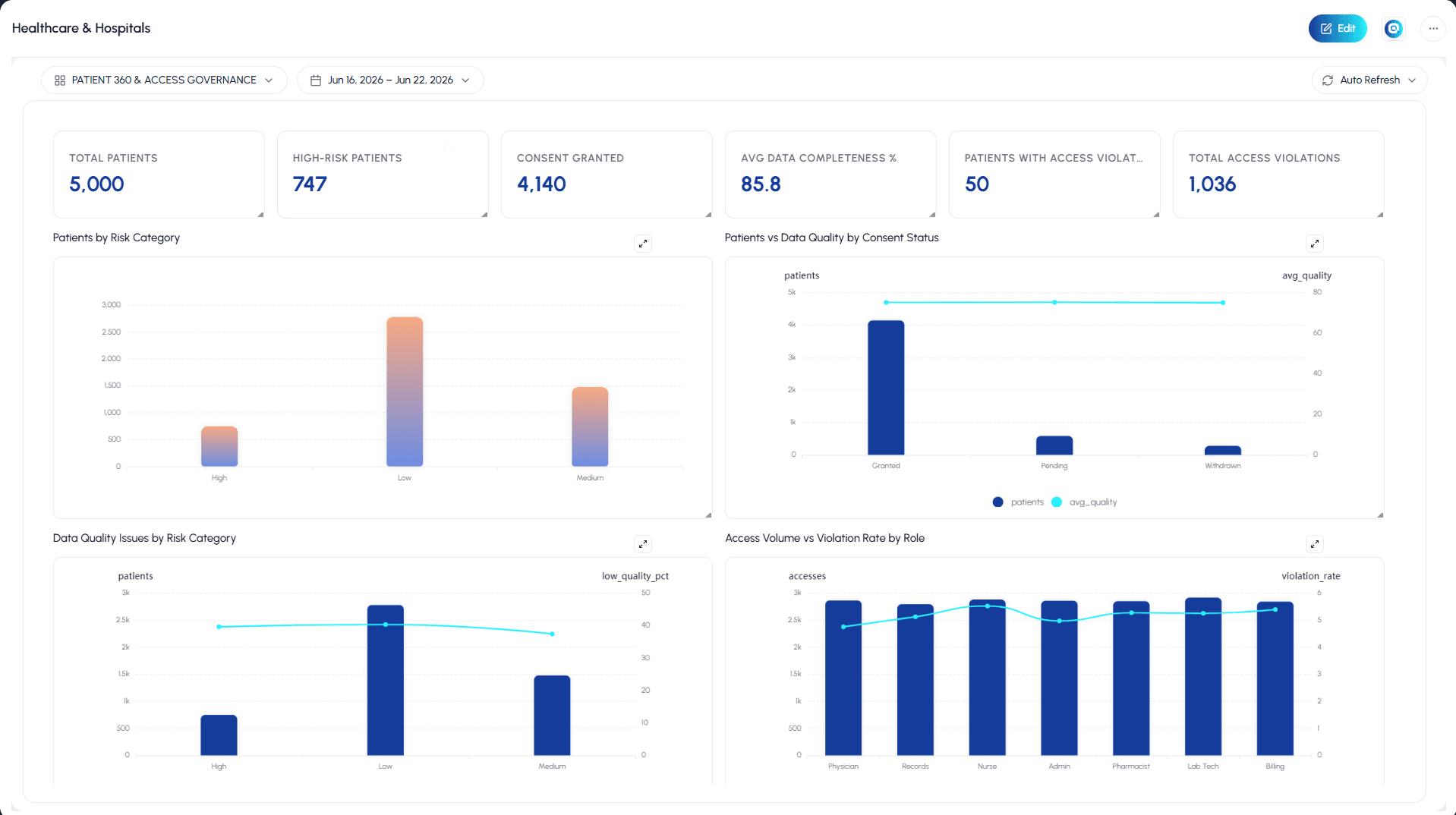
Cogrion's Patient 360 and Access Governance solution helps healthcare organizations create a unified patient intelligence layer without compromising privacy, consent, or control. By connecting patient records, risk categories, consent status, data-quality scores, user roles, access activity, resource types, and policy violations, Cogrion enables teams to understand patient context while continuously monitoring how sensitive information is used.
Patient and Governance Overview
Monitor patient population, high-risk patients, consent coverage, average data quality, patients with access violations, and overall access activity.
Patients by Risk Category
Group patients into high-, medium-, and low-risk categories to support governance reviews and appropriate care prioritization.
Consent Status and Data Quality
Compare patient volumes and data quality across granted, pending, and withdrawn consent statuses.
Data-Quality Issues by Risk Category
Identify whether incomplete or low-quality patient records are concentrated within specific risk groups.
Access Volume and Violation Rate by Role
Monitor how physicians, nurses, pharmacists, billing teams, and other roles access patient information and identify unusual activity.
Access and Violations by Resource Type
Compare access activity, consent verification, and violations across imaging, prescriptions, laboratory records, notes, claims, and other clinical resources.
Patient Access Violation Audit Queue
Provide compliance teams with a searchable list of affected patients, risk category, access activity, consent status, and related governance concerns.
How Cogrion turns healthcare data into trusted action
Connect
Bring together EHR records, laboratory results, prescriptions, imaging, appointments, admissions, discharge information, claims, billing, consent systems, access logs, pharmacy inventory, and hospital operations data.
Govern
Catalogue, validate, classify, mask, and secure sensitive data through lineage, consent controls, role-based access, data-quality rules, ownership mapping, and audit trails.
Understand
Build connected context across patients, clinicians, diagnoses, medications, encounters, departments, beds, claims, consent records, resources, and access events through Cogrion's ontology and semantic layer.
Predict
Generate intelligence around readmission risk, hospital capacity, medication demand, claim denials, patient-flow bottlenecks, and access anomalies.
Prioritize
Rank patients, compliance issues, capacity constraints, inventory risks, claim denials, and operational interventions according to urgency, impact, and risk.
Act
Turn intelligence into dashboards, alerts, intervention lists, compliance workflows, capacity decisions, replenishment actions, and revenue-cycle priorities.
Healthcare outcomes Cogrion helps enable
One governed intelligence layer across the patient journey
Cogrion does not replace EHR, laboratory, pharmacy, imaging, claims, billing, or hospital-management systems. It connects and strengthens them. By combining governed data, healthcare-domain relationships, semantic metrics, predictive intelligence, and role-aware access controls, Cogrion helps healthcare teams make trusted decisions across patient care, compliance, operations, inventory, and revenue management.
Healthcare-aware context
Connect patients, clinicians, encounters, diagnoses, medications, resources, consent, access activity, operations, and financial records.
Privacy-aware intelligence
Apply access policies, masking, consent controls, lineage, and auditability across sensitive patient information.
Explainable patient and operational insights
Support healthcare decisions with traceable metrics, connected source data, and understandable risk factors.
Persona-specific experiences
Deliver relevant dashboards and action queues to compliance teams, care managers, medical leaders, hospital operations, pharmacy teams, and revenue-cycle teams.
Ready to turn healthcare data into trusted intelligence?
See how Cogrion helps healthcare organizations connect patient, clinical, consent, operational, pharmacy, claims, and access data within one governed intelligence layer. Strengthen Patient 360, monitor sensitive-data access, identify risk earlier, improve hospital operations, and help teams act with greater confidence.